Coal in. Syngas out. Everything from there.
TRIG™ is a circulating transport gasifier that converts coal — including the difficult, low-rank coals other technologies refuse — into clean syngas: the universal intermediate for hydrogen, ammonia, methanol, fuels, and power.
How it works
01Coal particles continuously circulate through a fluidized transport reactor, converting to syngas at moderate temperature — below the point where ash melts and the problems of conventional gasification begin.
Prepare
Raw coal is dried and milled to specification — no washing, no slurry, no wastewater. A pressurized dry-feed system meters coal continuously into the gasifier.
Gasify
In the transport reactor, high solids circulation drives mixing, uniform temperature, and roughly 98% carbon conversion. Ash stays dry and is withdrawn continuously — no slag taps, no black water.
Clean
Dry candle filtration removes entrained particulate to better than 99.99% before the syngas is conditioned for downstream synthesis — or for power.
Inside the train
02The TRIG™ train, running as one line — coal in at the left, clean syngas out at the right, dry ash out the bottom. Built from engineering models of the development program that scaled to commercial service. Select any unit to cut into the breakdown.
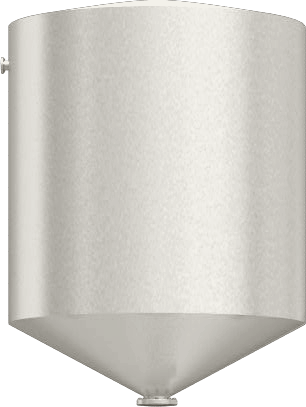
Coal storage
Dried, milled coal is held in atmospheric storage silos, ready for continuous feed. No washing, no slurry preparation — the coal stays dry from mill to gasifier.
Why TRIG™ outperforms
conventional gasifiers
03
Gasification is not new. What is new is a gasifier that avoids the failure modes — slag, slurry, refractory erosion, spare units — that have burdened conventional designs for decades.
Fine coal, extreme heat
Pulverized coal converts at 1,200–1,600°C — melting the ash into slag, punishing refractory, and demanding extensive coal preparation and water treatment.
Coarse coal, sticky tar
Coarse coal moves slowly through the reactor. Uncracked tar leaves with the syngas, requiring additional downstream clean-up and maintenance.
Continuous circulation
Fine coal particles continuously circulate and recycle, breaking down tar, keeping ash dry, and tolerating wide variability in particle size and quality.
| Parameter | Conventional slagging gasifiers | TRIG™ |
|---|---|---|
| Operating temperature | Above the ash melting point | 600–700°F below ash melting |
| Coal feed | Wet slurry feed | Dry coal feed |
| Ash removal | Molten slag — “black water” | Dry ash, no wastewater |
| Slag tap plugging | Frequent cause of outages | Eliminated entirely |
| Refractory damage | Severe erosion from molten ash | No molten ash contact |
| Spare gasifier | Required — adds ~30% capital | Not required |
| Coal washing | Often required | Not required |
| Feedstock flexibility | Limited by ash behavior | Handles 30%+ ash coals |
| Single gasifier capacity | Smaller units | Up to 7,500 tons per day |
| Internal moving parts | Various | None in the reactor loop |
Built for the coals
others can’t use
04
Most gasification is designed around ash — its melting point, its chemistry, its quantity. TRIG™ is designed so ash barely matters.
Most of the world’s coal is not the hard, clean, export-grade product of mining brochures. It is low-rank — high in moisture, high in ash, friable, and variable. Conventional gasifiers struggle with it. Many simply cannot run on it.
TRIG™ was designed for exactly this coal. Operating below the ash melting point makes ash chemistry irrelevant; dry feed makes moisture manageable; continuous circulation makes variability tolerable.
That design choice unlocks the reserves that matter most: the abundant, locally mined, low-cost coals that nations actually sit on.
Feedstock performance demonstrated on high-moisture, high-ash, highly variable lignite at commercial scale. See the operating record.
The loop outweighs the coal, one hundred to one
Inside the transport reactor, fresh coal is a rounding error. The loop circulates on the order of one hundred parts of hot solids for every one part of new feed — so temperature, chemistry, and hydrodynamics are set by the circulating bed, not by whatever arrived on today’s train. High ash, variable ash, swinging quality: the loop absorbs it.
And because TRIG™ operates 600–700°F below the point where ash melts, ash chemistry never becomes ash behavior. There is no slag to manage, no fusion temperature to engineer around, no washing step to pay for. Ash enters dry, rides the loop, and leaves dry — continuously.
Slagging never starts
The slagging behavior that dictates conventional gasifier design never enters the picture — no fluxing, no blending mandates, no molten-ash refractory attack.
Run-of-mine ready
No washing requirement means no washery yield losses and no process-water burden. High-ash coal feeds largely as it is mined — dried, milled, and in.
Discounted reserves become feedstock
Coals running 30–45% ash — long priced down because nothing could use them well — become the economic basis for hydrogen, fertilizer, and fuels projects.
One syngas.
A portfolio of products.
05
With the largest single-gasifier capacity on the market, TRIG™ enables poly-generation projects — producing several high-value products from a single train, matched to each market.
Hydrogen
Blue H₂ with integrated carbon capture
Ammonia
Fertilizer feedstock and hydrogen carrier
Urea
The world’s most-used nitrogen fertilizer
Methanol
Chemical feedstock and clean fuel blending
DME
Clean diesel substitute and LPG blendstock
SNG
Pipeline-quality synthetic natural gas
Synthetic fuels
Fischer–Tropsch diesel and jet fuel
Power
Syngas-fired combined-cycle generation
TRIG™’s performance is written in steel. Tens of thousands of hours of gasification operations behind every claim.